No products added!
November 18, 2026

What Does Bali Garment Manufacturer Actually Produce?
Bali Garment Manufacturer produces swimwear, activewear, resortwear, modest swimwear and activewear, streetwear, uniforms, and accessories including bucket hats. All categories are made in-house in Bali, Indonesia, and exported directly to buyers in Australia, the United States, Europe, and the Middle East. Recycled and eco-friendly fabric options are available across product categories for brands with sustainability requirements.
Swimwear covers bikinis, one-pieces, rash guards, and board shorts. Activewear includes leggings, sports bras, training tops, and compression shorts. Resortwear spans cover-ups, kaftans, and casual beach sets. Modest swimwear and activewear serve buyers who require fuller coverage silhouettes. Streetwear production covers hoodies, tees, and jogger sets. Uniforms are made for hospitality and corporate clients. Bucket hats and accessories round out the range for brands that want a complete coordinated product line.
Recycled fabric options, including materials made from post-consumer plastic bottles and regenerated nylon, are available on request. These are sourced and confirmed during the inquiry stage, not assumed as a default. If your brand has a specific sustainability requirement, raise it early so the factory can confirm the right fabric for your brief.
See the full range of what we produce for buyers who want the complete capability overview before submitting an inquiry.
How Does the Production Process Work End to End?
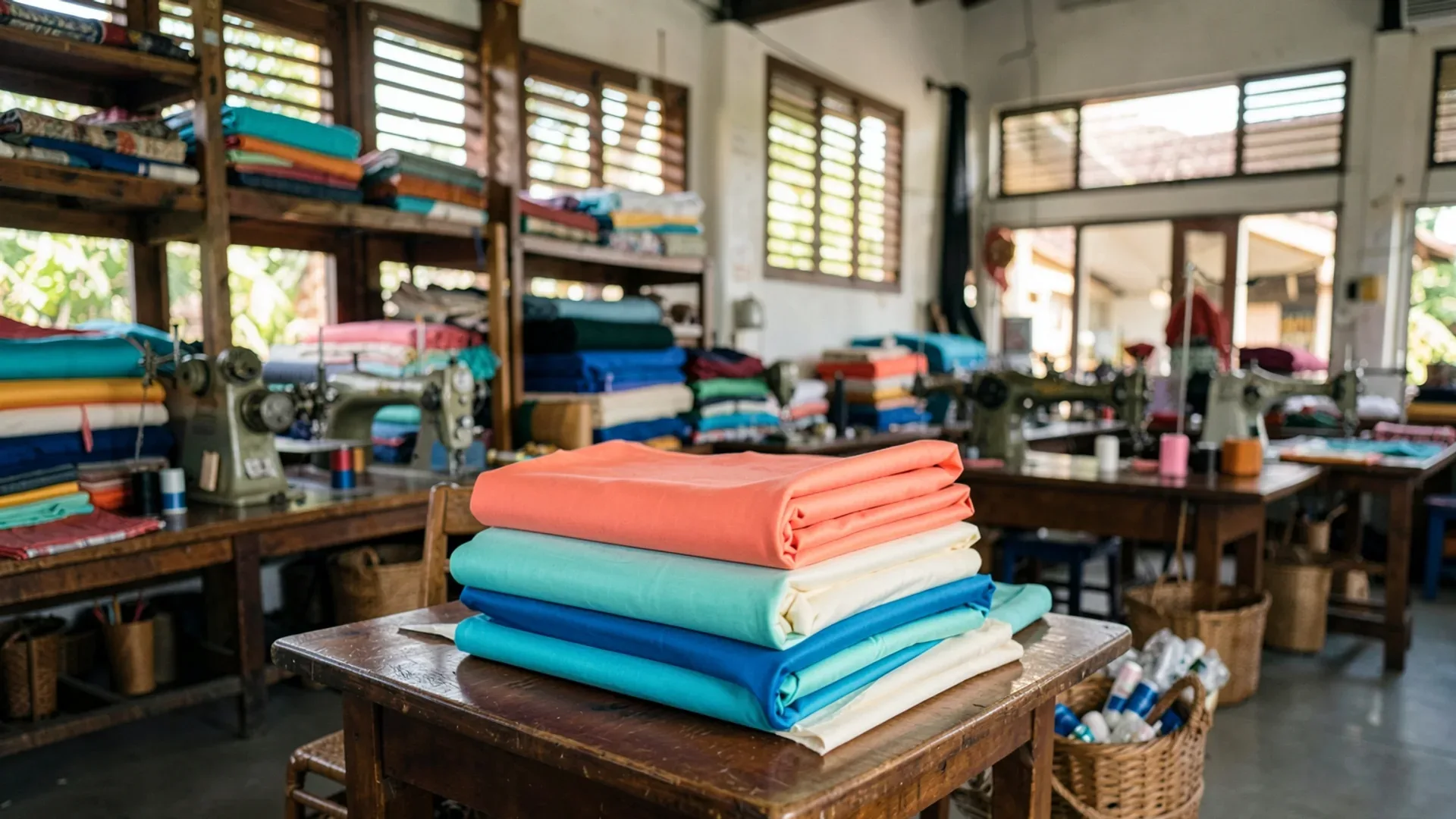
Every stage of production happens under one roof. That matters because the most common source of production delays is the coordination lag that appears when a broker subcontracts individual stages to separate suppliers. Here, the workflow runs in sequence without handoff gaps.
The process moves as follows:
- Digital pattern making and 3D design. Patterns are built digitally from a tech pack, sketch, or reference sample. 3D design tools allow fit and proportion to be reviewed before any physical fabric is cut.
- In-house fabric printing. Custom prints are executed in-house. This keeps print color accuracy under the same quality oversight as the rest of the garment.
- Cutting. Fabric is cut to pattern spec. Marker efficiency is managed in-house to minimize waste.
- Sewing. Seam construction, including flatlock and coverstitch techniques specific to swimwear and activewear, is done on the factory floor.
- Staged quality control. QC checkpoints run during production, not only at the final inspection. Issues are caught and corrected before they affect the full batch.
- Labels and packaging. Brand labels, hang tags, and packaging are applied in-house to the client’s specification.
- Export shipping. The factory holds its own export-import account, so goods ship directly without a third-party freight forwarder acting as an intermediary at the export stage.
The production lead at Bali Garment Manufacturer, Kadek Darma Putra, has more than 10 years of hands-on experience in quality control, pattern making, cutting and marking, tailoring, and production management. That background means technical decisions at every station are made by someone who has worked the station personally, not managed it from a distance.
Review the full factory service capabilities for technical specification detail on each production stage.
What Are the MOQ, Capacity, and Lead Time?
The factory accepts low-MOQ orders, making it accessible for startups testing the market, and scales to 25,000 pieces per month for established brands, so you never need to change factories as your volume grows. Sample lead times and bulk production timelines vary by product complexity and fabric sourcing. A confirmed timeline is provided at quotation; estimates given before that are not binding.
For startups launching their first collection, a low MOQ means you can test market response without committing to inventory levels that exceed your budget or storage capacity. The minimum quantity for a given product type depends on factors including fabric sourcing lead time and construction complexity. The factory confirms the specific MOQ applicable to your order at the inquiry stage.
For established brands, the 25,000 pieces per month capacity means production can scale without sourcing a second factory. That continuity matters: a factory that already holds your patterns, fabric preferences, and QC standards produces more consistently than a new supplier starting from scratch.
On lead time, a typical sample development period runs from a few weeks to a longer window depending on whether fabric needs to be imported or sourced locally. Bulk production timelines are confirmed after sample approval, based on the confirmed order volume and fabric availability at that point. The factory does not publish fixed delivery windows because shipping mode, customs clearance, and order size all affect the final date. The timeline you receive at quotation reflects actual current conditions, not an averaged estimate.
What Is the Duty-Free Fabric Import Facility and Why Does It Matter?
The factory holds its own duty-free fabric import facility, which means certain imported fabrics enter the factory without incurring the standard Indonesian import tariff. This is a licensed facility, not an informal arrangement. The mechanism is well established under Indonesian trade regulations administered by the Ministry of Industry of the Republic of Indonesia.
In practical terms, this reduces the per-unit material cost for buyers. Factories that do not hold this facility either absorb the import tariff into their pricing or pass it through as a line item. Neither outcome is as cost-efficient as sourcing from a facility that is exempt from the tariff at the point of import.
The benefit applies specifically to imported fabrics used in export production. This aligns with the WTO framework on textile trade, under which duty drawback and duty exemption schemes for export-oriented manufacturers are a recognized mechanism for keeping export production competitive.
For buyers comparing factory quotes from different production countries, the duty-free facility is a structural cost advantage that does not depend on negotiation. It is built into how the factory operates. The full detail of how this works is explained on the duty-free facility page linked above.
Which Markets Does the Factory Export To?
The factory exports primarily to Australia, the United States, Europe, Kuwait, and the broader Middle East. Each market connects to the factory for reasons grounded in production capability, not just geography.
Australian brands are among the most active users of the factory’s low MOQ entry point. The Pacific shipping lane from Bali is relatively short, and Australian swimwear and activewear brands frequently need smaller production runs with quick iteration cycles as they test new styles or seasonal colorways.
US and European brands typically come to the factory when moving production away from Chinese suppliers. The main reasons cited are better direct communication, an English-speaking production lead, competitive per-unit costs supported by the duty-free facility, and a more flexible MOQ structure than most Chinese factories offer at comparable quality.
Brands serving Kuwait, the UAE, and broader Middle East markets come specifically because the factory produces modest swimwear and modest activewear. Coverage requirements in these markets differ substantially from standard Western swimwear silhouettes, and not all manufacturers have worked through the construction specifics of modest styles. This factory has.
All export shipments move through the factory’s own export-import account. Transit times and shipping mode options are confirmed at quotation based on destination, volume, and delivery requirements. The factory does not publish fixed transit times because these depend on variables outside the production stage.
How Does Private Label and Custom Label Work?
Both private label and custom label production are available from the same production line.
Private label means the finished garment carries your brand’s identity. The factory produces the garment and applies your labels, hang tags, and packaging according to your specifications. The buyer receives a product ready to sell under their own brand.
Custom label means the factory produces the garment and applies client-specified labeling. The distinction from private label is primarily one of branding scope: custom label can refer to labeling a factory-developed style, while private label typically involves the buyer’s own design or developed specification.
Product development support is available as part of both services. If you are starting from a sketch, a reference image, or an existing sample rather than a completed tech pack, the factory can work through the development process with you. The output is a confirmed sample and a production-ready pattern before bulk manufacture begins.
Tech pack input is the most efficient starting point if you have one. If you do not, the factory can work from reference materials and document the spec as part of sample development. Either path leads to the same production-ready result.
How Do I Start Working with Bali Garment Manufacturer?
The process from first contact to bulk production follows four steps:
- Submit your inquiry. Include your product category, an estimated quantity, and any reference materials you have. A sketch, tech pack, or existing sample all work as a starting point. The more detail you provide, the more specific the factory’s response can be.
- Receive feasibility and sample cost. The factory reviews your inquiry and responds with a feasibility assessment, recommended fabrics suited to your product and market, and a sample development cost. This is where MOQ, timeline estimates, and pricing direction are discussed.
- Develop and approve a sample. A physical sample is produced. You review and provide feedback. Revisions are made until the sample matches your specification. Bulk production does not begin before sample sign-off.
- Confirm bulk production. Once the sample is approved, the factory provides a confirmed production timeline and bulk pricing. Production runs against that confirmed schedule.
If you are still comparing factory options before submitting an inquiry, the buyer evaluation checklist is a useful pre-inquiry resource. It covers the questions worth asking any factory before you commit to sampling.
When you are ready, send your inquiry with your product category, estimated quantity, and reference materials. The factory will respond with a clear next step.
Frequently Asked Questions
- What is the minimum order quantity at Bali Garment Manufacturer?
- The factory accepts low-MOQ orders designed for startups and brands testing the market. The exact minimum depends on the product type and fabric sourcing. Contact the factory with your product category and estimated quantity to receive a specific MOQ confirmation for your order.
- Does Bali Garment Manufacturer offer private label production?
- Yes. The factory provides both private label and custom label services. This includes applying your brand’s labels, hang tags, and packaging to finished garments. Product development support, from sketch or tech pack through to sample, is available as part of the service.
- Can Bali Garment Manufacturer produce modest swimwear and activewear?
- Yes. Modest swimwear and modest activewear are among the product categories the factory produces. This is specifically relevant for brands serving buyers in Kuwait, the UAE, and broader Middle East markets, where coverage requirements differ from standard swimwear silhouettes.
- How does the duty-free fabric import facility benefit buyers?
- The factory holds its own duty-free fabric import license in Indonesia. This means certain imported fabrics bypass the standard import tariff, lowering the per-unit material cost. The saving is passed through to the buyer’s production cost rather than absorbed as a factory margin.
- Does Bali Garment Manufacturer use recycled or sustainable fabrics?
- Recycled and eco-friendly fabric options are available for buyers with sustainability requirements. The factory does not make absolute claims about specific certified fabric brands. If your brand requires a particular fabric specification, raise it during the inquiry stage so the factory can confirm availability.
- How long does production take from sample approval to delivery?
- Lead time varies by product complexity, order volume, and whether fabric needs to be imported. A confirmed production timeline is provided at quotation. The factory does not publish fixed delivery windows because variables like customs clearance and shipping mode affect the final date.