No products added!
October 25, 2026

Introduction: Why These Questions Matter Before You Commit to a Factory
Bali Garment Manufacturer has been producing and exporting swimwear, activewear, and resortwear since 2013. The business was founded by Kadek Darma Putra, who has spent more than a decade working hands-on across quality control, pattern making, cutting, and production management. That background shapes how every order is handled, from first inquiry to shipment.
The questions below come directly from buyers in Australia, the US, Europe, and the Middle East who contacted the factory during their sourcing research. None of them are invented. They are the real concerns that determine whether a factory relationship works. Here are the 10 questions we get most, answered plainly.
What Is the Minimum Order Quantity at a Bali Garment Factory?
MOQ at Bali Garment Manufacturer is designed to suit startups testing the market as well as established brands scaling up. We work across both ends of the volume range, from small initial runs up to 25,000 pieces per month, so a brand never needs to change factories as it grows. The exact starting MOQ depends on the product type and fabric: more complex constructions require a higher minimum to cover pattern and sampling cost efficiently.
A simple cut-and-sew style in a standard fabric will have a lower starting MOQ than a printed piece with bonded seams and custom hardware. Fabric-intensive products such as structured activewear or lined swimwear sit somewhere in between. The honest answer is that MOQ is a conversation, not a fixed gate. Bring your product details and we will give you a real number. You can read about our factory services to understand the full scope of what we handle under one roof.
Do I Need a Tech Pack to Start an Order?
A complete tech pack produces the most accurate first sample and the fewest revision rounds, so we recommend having one. If you are starting from a sketch or a reference garment, we can work with that during the product development stage, our team handles digital pattern making and 3D design in-house. At minimum, we need your measurements, preferred fabric, intended market, and any construction details you know. The more detail, the fewer surprises in sampling.
A buyer who arrives with a polished tech pack moves faster through sampling. A buyer who arrives with a photo and a fabric swatch can still move forward, the development stage just takes longer and may require one or two more revision rounds before the sample is approved. Either path works; the difference shows up in lead time and sampling cost.
How Long Does Sampling Take Before Bulk Production?
Sampling lead time typically runs several weeks from the point when all product details and fabric are confirmed. The main variables are construction complexity, fabric availability, and how many revision rounds the sample needs before approval.
A straightforward style in a fabric we already stock moves faster. A new print, a bonded or flatlock seam finish, or hardware that needs to be sourced adds time. Getting sampling right is not a step to compress. The staged quality control process that protects bulk production starts at the sample stage: seam integrity, print placement, sizing accuracy, and fit are all checked before a single bulk unit is cut. Rushing the sample approval to save a week almost always costs more time when problems surface at bulk inspection. Plan sampling and bulk production as two distinct phases.
What Fabrics Can a Bali Garment Factory Source for Swimwear and Activewear?
Standard performance fabrics for swimwear include nylon-spandex and polyester-spandex blends with UPF and chlorine-resistance properties. Activewear typically uses moisture-wicking four-way stretch fabrics. Recycled and eco-friendly fabric options are available for both categories. If sustainability is a requirement for your brand, raise it at the inquiry stage so fabric sourcing is confirmed before sampling begins.
In-house fabric printing is available, which means custom prints can be developed and applied without sending fabric to an outside vendor. This keeps print quality under direct control. Our duty-free fabric import facility allows the factory to import fabric without paying standard Indonesian import duty, which lowers material costs. That saving flows through to your per-unit cost without requiring you to manage any import paperwork.
What Does the Production Process Look Like From Start to Shipment?
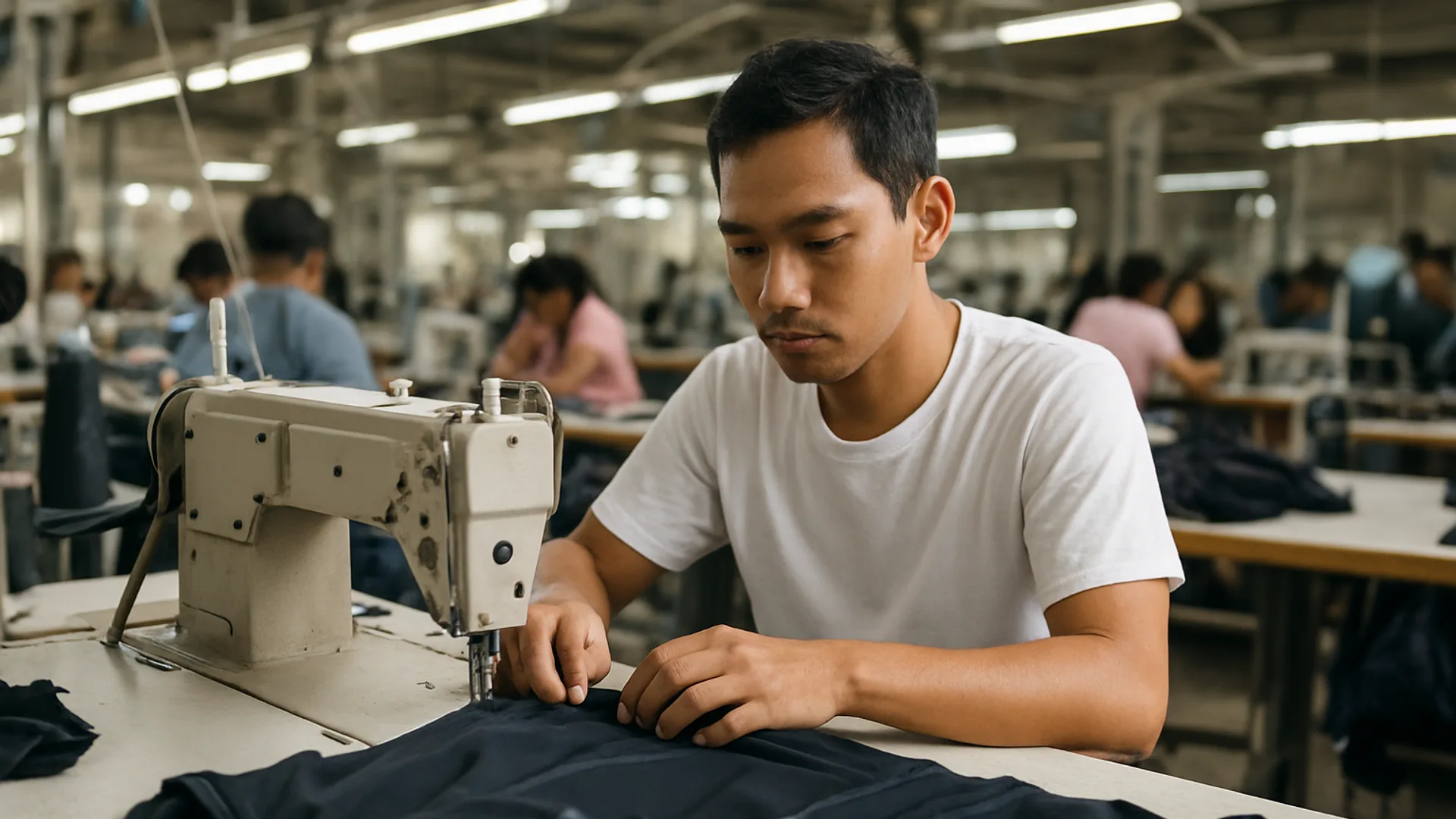
The stages run in this order: digital pattern making, sampling, sample approval, fabric cutting, sewing, staged quality control, labelling and packaging, and then export. Every one of those stages happens under one roof. No work is outsourced between steps, which means quality handoffs are controlled and communication stays direct.
That one-roof model is the practical difference between a factory and a broker: there is no gap where a garment moves between unknown facilities. For a full walkthrough of how each stage works, read the complete production process from sketch to shipment. This section covers the sequence; that article covers the detail.
How Does Quality Control Work at a Bali Garment Factory?
Quality control runs in stages rather than as a single end-of-line check. In-process checks cover seam construction, print registration, and cut accuracy while production is still in progress. A pre-packing inspection reviews finished garments for fit, finish, and any cosmetic issues before units are folded and bagged. A final audit happens before the shipment is sealed.
Kadek Darma Putra’s background in quality control directly shapes how these checkpoints are structured. No factory can honestly claim zero defects in bulk production. What staged QC does is catch issues early, when correction is still practical and cost-effective. The buyer’s role matters too: a thorough sample approval before bulk production cuts is the single most effective quality protection available to both sides.
Can I Get Private Label or Custom Label on My Garments?
Yes. Both private label and custom label services are standard. This covers woven labels, hang tags, care labels, and branded packaging. Label artwork needs to be submitted before bulk production begins so it can be incorporated into the packing stage without delaying the shipment date.
The practical benefit is straightforward: the factory’s craftsmanship is behind the product, but your brand is on it. Whether you are launching a new swimwear line or scaling an existing activewear brand, the labelling and packaging that reaches your customer reflects your identity, not the manufacturer’s. Submit artwork in the correct format and at print-ready resolution to avoid delays at that stage.
How Does Shipping and Export Work from Bali to Australia, the US, or the Middle East?
We hold our own export-import account, so orders ship directly without a broker in between. For bulk orders, sea freight is the standard mode, more cost-effective over long distances. For urgent or smaller top-up shipments, air freight is available. Transit time and cost depend on destination and volume: Australia is the shortest route from Bali, while the US, Europe, and Kuwait involve longer transit by sea. Exact shipping costs are quoted per order.
Holding a direct export account removes the margin and communication layer that a freight broker or trading company would otherwise add. Shipping documentation, customs declarations, and export compliance are handled by the factory as part of the order process. The buyer receives the goods; the logistics behind the shipment are managed on this end.
What Is a Duty-Free Fabric Import Facility and How Does It Benefit My Brand?
A duty-free fabric import facility is a government-recognised status that allows the factory to import fabric without paying standard Indonesian import duty. Bali Garment Manufacturer holds this facility directly. That means sourcing cost on imported fabric is lower, and that saving flows through to your per-unit cost. As a buyer, you do not manage the paperwork; the factory handles it as part of the production process.
In practical terms, this matters most when the right fabric for your product is not available domestically. Performance swimwear fabrics, technical activewear materials, and specialty eco-friendly textiles are often imported. Without the duty-free facility, that import cost sits in your unit price. With it, the factory absorbs the duty saving and passes it through. Learn more about how this works at our duty-free fabric import facility page.
Is Bali a Reliable Place to Manufacture Garments for International Brands?
Yes, when you choose a factory with a verified track record. Bali has a well-established garment export sector supported by skilled local artisans, direct access to international freight routes, and a manufacturing culture built around swimwear, activewear, and resortwear. Indonesia’s textile and garment industry is regulated at the national level, with oversight from the Ministry of Industry and broader economic context tracked by institutions such as Indonesia Investments.
The reliability question comes down to the specific factory, not the island. Direct founder communication, a clear QC process, a real export account, and a production history across multiple international markets are the indicators worth checking. For a deeper look at why brands from Australia, the US, Europe, and the Middle East consistently return to Bali, read why global brands choose Bali for manufacturing.
Ready to Start a Conversation with a Bali Garment Factory?
This factory suits startups testing the market with a small initial run, growing brands that need room to scale, and established brands moving production away from a factory that no longer fits. Before you reach out, it helps to know what every buyer should evaluate before choosing a factory.
When you are ready, send us your brief and get a straight answer.
Leave a Reply
Related Posts
March 16, 2025
Bali Garment Manufacturer – Kain tekstil telah menjadi bagian penting dalam kehidupan manusia sejak zaman dahulu. Dari...